
Research Project INCRE


Inferring Continuous-Time Reaction Models from Time-Series Data
Duration:
Project coordination:
Scientific staff:
Source of funding:
01.01.2027 - 31.12.2029
Prof. Adelinde M. Uhrmacher,
Prof. François Fages (Inria)
M.Sc Glenn Skrzypczak,
M.Sc. Justin N. Kreikemeyer
German Research Foundation - DFG,
French National Research Agency - ANR
Abstract
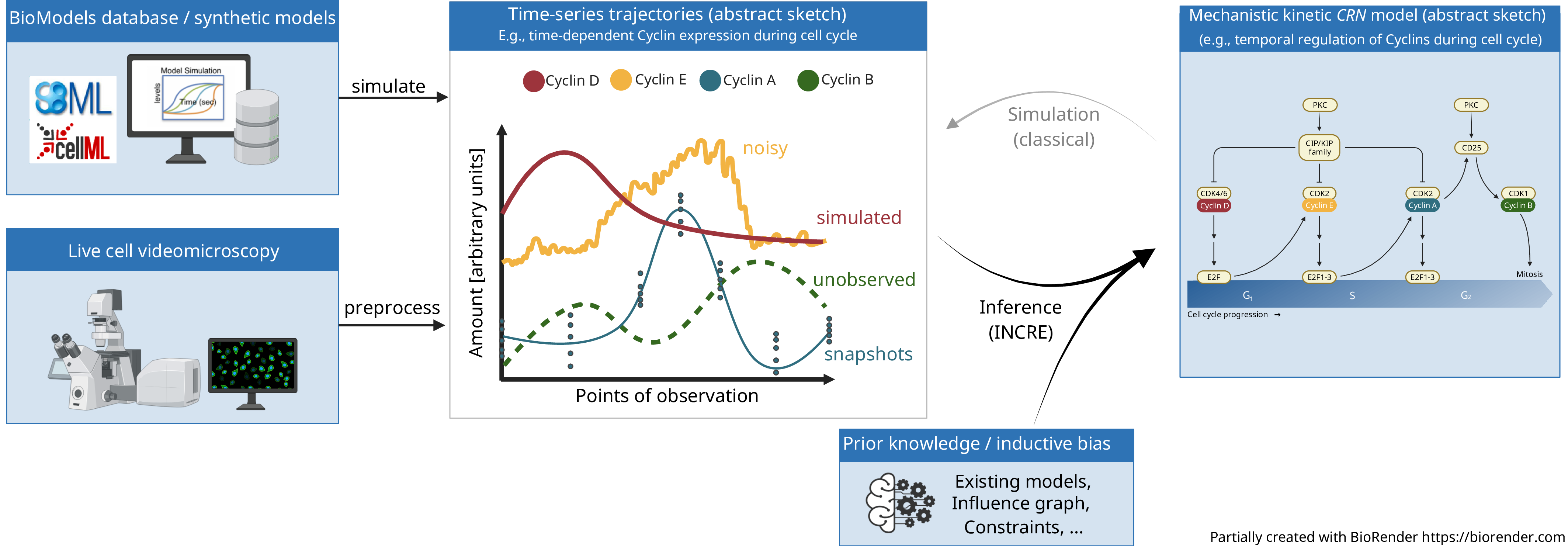
Machine learning methods are transforming many areas of science and open up new opportunities for developing quantitative simulation models. A particularly promising direction, and the focus of INCRE, is inferring mechanistic simulation models directly from time-series data. In particular, the project will develop new methods to infer chemical reaction networks, a standard modeling formalism in systems biology.
In systems biology, Chemical Reaction Networks (CRNs) provide a well-established formalism for modeling molecular interaction processes under both deterministic continuous-time interpretations based on ordinary differential equations (ODEs) and stochastic interpretations based on continuous-time Markov chains (CTMCs). Despite recent progress, inferring CRN models from experimental time-series data remains challenging. Key open problems include robustness to noisy and partially observed data, the presence of unobserved variables, the integration of prior biological knowledge to enhance interpretability, and the lack of standardized benchmarks for evaluation. The project INCRE (Inferring Continuous-Time Reaction Models from Time-Series Data) aims to address these challenges by developing new methods for the inference of CRNs from temporal data. INCRE will build on the partners’ prior work in learning CRN models, with a particular focus on beam search techniques and simulation-based learning methods. In addition, the project will develop benchmark datasets and evaluation protocols to enable systematic comparison of methods and to foster progress in data-driven simulation model inference. A central aspect of INCRE is the collaboration between Inria Paris-Saclay and the University of Rostock, which brings together complementary expertise in formal modeling, simulation, and data-driven development of cell biological models. The expected outcomes of INCRE include novel algorithms, informative benchmarks, and methodological advances that will benefit both the systems biology community and the broader field of data-driven inference of simulation models.