
Joint Research Consortium ADAPTI-M
Workpackage 3: Intelligent NPI-Strategy-Generation und Optimization
Runtime:
Leder of ADAPTI-M:
PI for WP3:
Contributors to WP3:
Scientific Staff:
Financing:
01.01.2026 bis 31.12.2029
Prof.Dr. Rafael Mikolajczyk,
Martin-Luther-University Halle-Wittenberg
Prof.Dr. Adelinde Uhrmacher, University of Rostock
Prof. Dr.-Ing. Bernd Hellingrath, Univ.-Prof. Dr. André Karch, University of Münster
Prof. Dr. Tyll Krüger,
Wroclaw University of Science and Technology (Poland)
Prof. Dr. Matthias Müller-Hannemann,
Martin-Luther-University Halle-Wittenberg
Dr. Frank Sandmann, Robert Koch-Institut, Berlin
Prof. Dr. Markus Scholz, University of Leipzig
Federal Ministry of Research, Technology and Space (BMFTR)
Abstract
This work package examines methods that automatically generate and optimize non-pharmaceutical interventions (NPIs) for infectious diseases to support decision makers.

Student Assistants: Welcome!
(Please reach out to us if you are interested.)
ADAPTI-M: Next generation modeling: Adaptive system to support decision making in the context of public health during pandemics of respiratory diseases
The COVID-19 pandemic has shown that simulating the spread of infection can help decision-makers plan interventions such as closing schools or ordering self-isolation. The goal of ADAPTI-M is to improve pandemic preparedness in the field of respiratory infections by implementing possible interventions and investigating their effects in silico for respiratory pathogens with a wide range of characteristics. The German epidemic microsimulation system (GEMS) developed in the OptimAgent -https://webszh.uk-halle.de/optimagent/ - preliminary project is to be further developed into a next-generation modeling approach. To this end, artificial intelligence approaches will be used for parameterization and automation.
Among other things, all measures introduced during the COVID-19 pandemic will be implemented to investigate their effectiveness in silico. In addition, an explicit behavioral model describing compliance with infection control measures as a function of sociodemographic characteristics will be implemented to represent different impacts on vulnerable groups. Moreover, the evolutionary dynamics of pathogens will be included in order to develop tools for the development of new variants during the pandemic.
Workpackage 3: Intelligent NPI-Strategy-Generation und Optimization
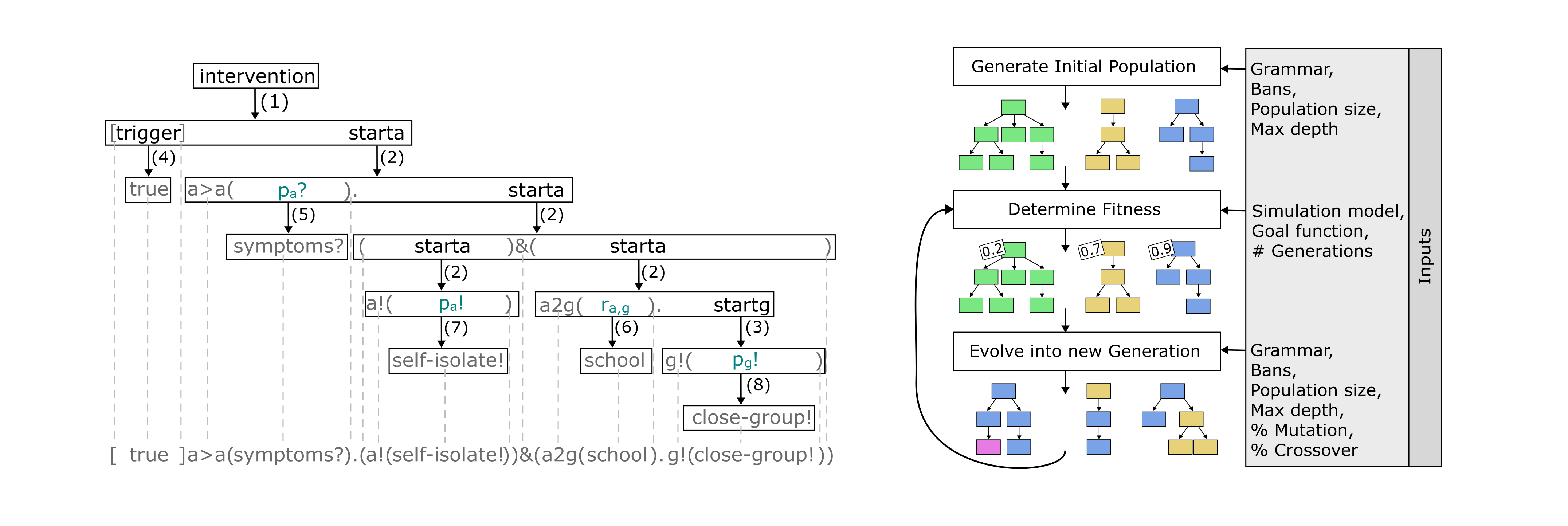
The task of work package 3 (WP3) is the intelligent generation and optimization of NPI strategies. One of the main features of GEMS is its formalized approach to modeling highly complex intervention strategies. The so-called “TriSM” approach ("Trigger, Strategy, Measure") enables complex, nested, cascading, and recursive strategies to be accurately represented, such as a positive PCR test leading to the isolation of the individual, which in turn triggers the tracing of their contacts and the application of PCR tests to the detected contacts (cascade effect). While ODE models and many of the available agent-based models approximate such detection and isolation rates by the increase or decrease in the overall infection intensity in a population, GEMS can explicitly and in great detail model the sequence of events (as specified by public health guidelines or legal frameworks such as the Corona-Schutzverordnung) (Ponge et al. 2024 - https://ieeexplore.ieee.org/document/10838778/). TriSM provides intervention measures as “building blocks” (e.g., “isolate person X,” “find contacts of Y,” “close school Z”) that can be combined, conditioned, or delayed. It is also possible to vary strategies for different geographic regions, age groups, or occupations and to incorporate psychological feedback effects (e.g., change in adherence).
In conjunction with the high-resolution population model provided by GEMS, it is now possible to explore a virtually infinite number of intervention strategies that can be assembled from the available “blocks.” This wealth of possibilities comes with the challenge of operationalizing such a system for real-life decision-making and answering the question: “How do you find a good strategy?”, taking into account the different perspectives of decision-makers and the conflicting goals of various interest groups. Therefore, WP3 focuses on the automatic simulation-based optimization of intervention strategies. This requires a reliable and stable simulation model. Therefore, WP3 will also aim to automate other simulation experiments to obtain valuable information about the simulation model (Wilsdorf et al. 2023 - https://dl.acm.org/doi/10.1145/3564928).